
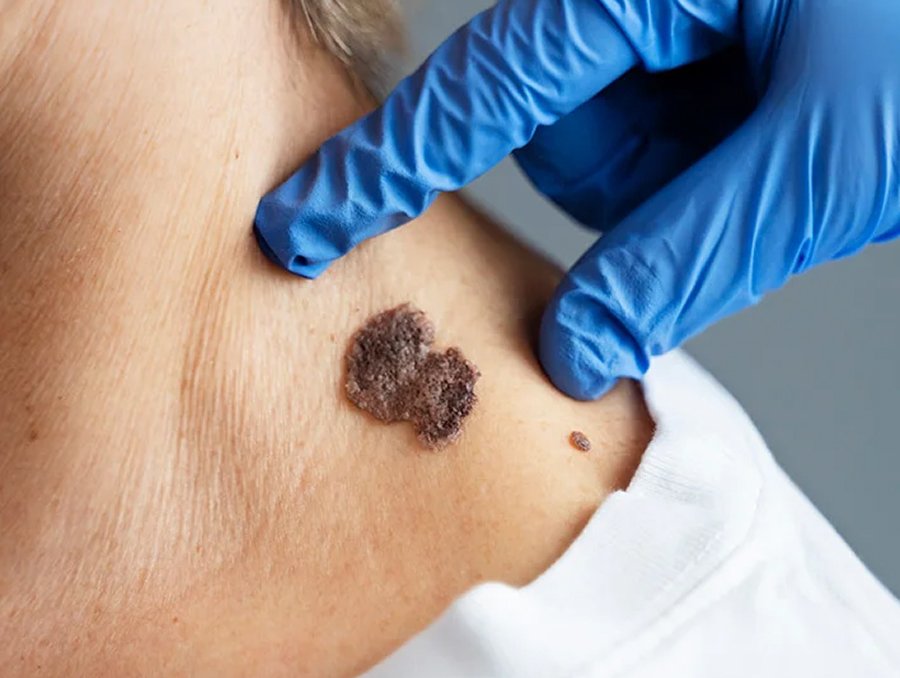
Squamous cell carcinoma is a type of skin cancer that originates from abnormal proliferation of keratinocytes in the epidermis. It is the second most common skin cancer after basal cell carcinoma; accounting for approximately 20% of non-melanoma skin cancer cases. Its incidence has increased in recent decades due to longer life expectancy, greater sun exposure, the use of tanning beds, and improved detection of this type of tumor.1 In the United States, the incidence is estimated at between 200,000 and 400,000 new cases each year. In Colombia, the incidence of skin cancer rose from 23 cases per 100,000 inhabitants in 2003 to 41 cases per 100,000 in 2007; of these, 25% were squamous cell carcinomas.2 It is more common in men than in women, with a ratio of 3:1; and its incidence increases with age.
Main risk factors
The main risk factors that contribute to its development are exposure to ultraviolet radiation, low skin types, exposure to certain chemicals such as arsenic or hydrocarbons, scars or chronic inflammation, human papillomavirus infection, immunosuppression, tobacco use, and pre-existing genodermatosis. 4,5
In terms of its name, when the tumor is located exclusively in the epidermis or in the appendages above the basement membrane, it is called “squamous cell carcinoma in situ,” and when it passes through the dermis and underlying tissues, it is called “invasive squamous cell carcinoma.” 6 In most cases, it is localized and has high cure rates, but in up to 5% of cases, local, regional, or distant metastases occur. 7 Although the literature has identified some clinical and histopathological predictors that lead to a higher risk of recurrence or metastasis, there is no consensus on the definition of high-risk squamous cell carcinoma, nor on the best tests for its diagnostic study, prognosis, and management. Therefore, this review aims to present an approach based on the best available evidence.
Definition of high-risk squamous cell carcinoma
There is no consensus on the definition. Multiple scientific societies have described “high-risk” characteristics, but these do not coincide with each other (Table 1). A retrospective study evaluated 257 patients diagnosed with squamous cell carcinoma using the criteria of the National Comprehensive Cancer Network (NCCN) and the American Joint Committee on Cancer (AJCC) and found significant differences: according to the AJCC, 14% were high risk, while 87% were high risk according to the NCCN criteria.
The purpose of the AJCC guidelines is to stratify individuals into groups with similar outcomes in order to calculate prognosis. One of the biggest problems with the AJCC guidelines is that they only take tumor factors into account, without considering patient factors such as immunosuppression or recurrence.9 The NCCN guidelines, on the other hand, seek to guide tumor treatment. One of the drawbacks of these guidelines is that they consider 12 high-risk factors, and having one of them already classifies the tumor as high risk, but they do not stratify different degrees of risk and do not differentiate between a tumor with a single high-risk factor and one with more than one factor, which could lead to higher rates of recurrence or metastasis.
Clinical features
A tumor diameter greater than two centimeters has been described as a high-risk factor. A review article that included multiple clinical trials from the last 50 years showed that these tumors had recurrence and metastasis rates of 15% and 30%, respectively, compared to those smaller than two centimeters, which had recurrence rates of 7% and metastasis rates of 9%.10 In addition, smaller tumors in special areas such as the head and neck are high risk: Veness and colleagues found that 70% of lesions in this location that metastasized were less than two centimeters. 11 The AJCC guidelines determine that a tumor larger than two centimeters is high risk, while the NCCN guidelines are more specific and recommend stricter diameters depending on the location of the tumor.
Some body locations have also been associated with a higher risk. For example, local recurrence in tumors of the lip and ear is 2-20%, and metastasis occurs in 5-19% and 9-12% of cases, respectively.12 Tumors involving the cheek also have a higher risk of metastasis compared to other locations, such as the legs. 7 Local recurrence increases the risk of metastasis and should be included in the high-risk criteria. The appearance of tumors at sites of chronic wounds, scars, previous burns, or radiotherapy sites suggests aggressive behavior, with metastasis rates averaging between 20 and 50%.
Table 1. High-risk criteria for squamous cell carcinoma of the skin.
|
|
|
|---|---|
|
National Comprehensive Cancer Network (NCCN).
Taken from Bichakjian et al44 |
American Joint Committee on Cancer (AJCC). Taken from Warner et al23
|
|
In an area larger than 20 millimeters (trunk and extremities, excluding pretibial, hands, feet, nail unit, and ankles)
|
Invasion greater than two millimeters deep
|
|
In areas larger than 10 millimeters (cheeks, forehead, scalp, neck, pretibial)
|
Perineural invasion
|
|
In areas larger than six millimeters (central face, eyebrows, eyelashes, periorbital area, nose, lips, chin, jaw, preauricular area, postauricular area, genitals, hands, and feet)
|
Location on the lip
|
|
Poorly defined edges
|
Tumor larger than two centimeters (stage T2)
|
|
Recurrent tumors
|
Clark Senior IV
|
|
Immunosuppressed individual
|
Location in ear
|
|
Previous site of radiation therapy or chronic inflammation
|
Poorly differentiated or undifferentiated
|
|
Fast-growing tumor
|
|
|
Neurological symptoms
|
|
|
Adenoid, adenosquamous, or desmoplastic subtypes
|
|
|
Moderately or poorly differentiated
|
|
|
Perineural, lymphatic, or vascular involvement
|
|
|
Depth equal to or greater than two millimeters or Clark IV or V
|
|